 Bahasa Indonesia
 English
 Fakultas Psikologi
Universitas Negeri Yogyakarta
Jalan Colombo No. 1
Karangmalang Sleman, Yogyakarta 55281
Indonesia
Alamat surel: humas_fp@uny.ac.id, sekretaris.dekanfp@uny.ac.id
Instagram: @psikologiuny
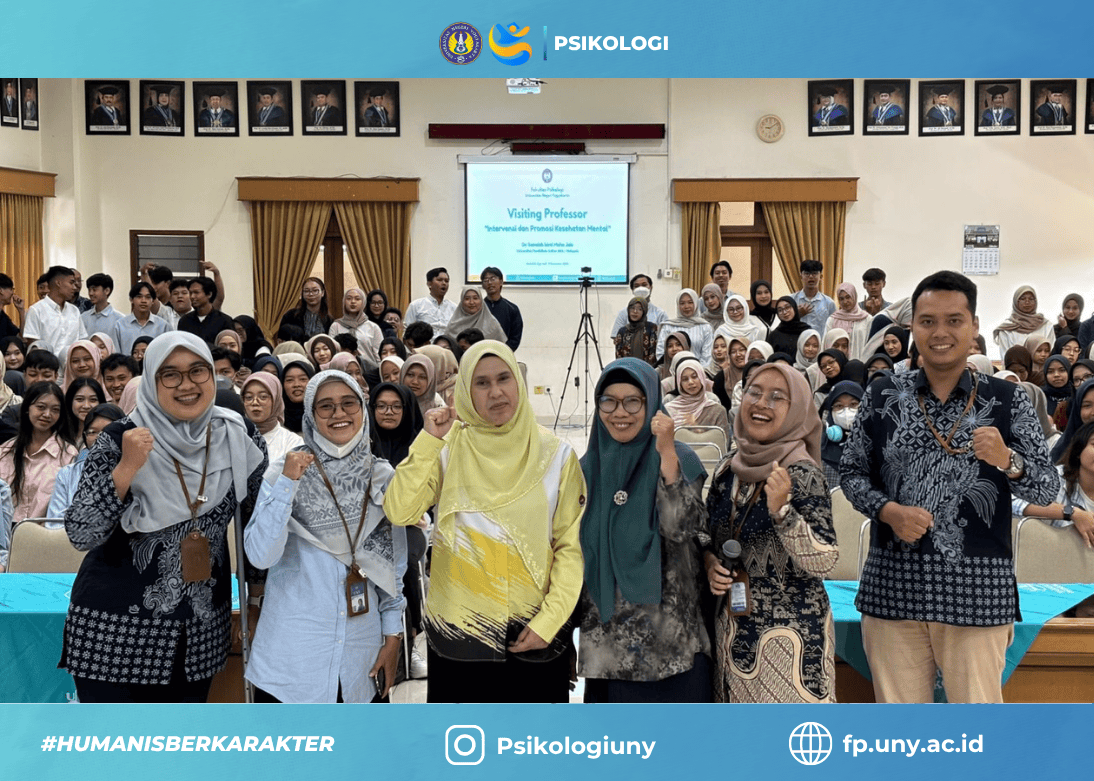
Yogyakarta, 11 November 2025 — The Faculty of Psychology at Yogyakarta State University once again held a Guest Lecture Visiting Professor event featuring international expert Dr. Samsiah Binti Mohd Jais, a lecturer from the Department of Psychology and Counseling, Faculty of Human Development, Sultan Idris Education University (UPSI), Malaysia.
The event, themed “Intervention and Promotion of Mental Health,” took place on Tuesday, 11 November 2025, from 07.00 to 11.00 WIB, at the Abdullah Sigit Hall, 3rd Floor, Faculty of Education, UNY.
The program was attended by approximately 189 Psychology students, lecturers, and administrative staff who enthusiastically participated in this cross-country academic exchange.
In her opening remarks, the Dean of the Faculty of Psychology UNY, Dr. Siti Rohmah Nurhayati, S.Psi., M.Si., Psychologist, delivered her appreciation and expectations for this academic collaboration:
“Mental health is a global issue that requires cross-national attention. Through this guest lecture, we hope that students will gain a broader understanding of intervention approaches and mental health promotion at both school and community levels. Collaboration with UPSI Malaysia is an important step in strengthening scientific networks and psychological practice across countries.”
In her presentation, Dr. Samsiah systematically explained the concepts, prevalence, impacts, and strategies for managing mental health, particularly within school environments.
She began with the World Health Organization’s (WHO) definition of mental health as a state of complete physical, mental, and social well-being—not merely the absence of illness. Mental health, she continued, strongly influences how individuals think, behave, interact, and make decisions in their daily lives.
In the next section, Dr. Samsiah emphasized the important role of schools as strategic environments for supporting the psychological well-being of children and adolescents. She cited studies by Dunn (2016) and Atkins (2018), which highlight that young people spend most of their time in school, making it the most potential setting for mental health promotion and prevention efforts.
As a key strategy, she introduced the School Mental Health Framework (Cavioni, Ornaghi & Grazzani, 2020), which focuses on three main approaches: developing students’ social–emotional skills (Social Emotional Learning/SEL) and resilience, preventing the emergence of risky behaviors and emotional difficulties, and providing sustained intervention and support for students experiencing mental health problems.
Dr. Samsiah also outlined the PREPaRE Model (Prevent, Reaffirm, Evaluate, Provide & Respond, Examine) as a comprehensive guideline for crisis management in schools. The model includes primary prevention efforts such as coping skills training and conflict resolution; secondary prevention, which involves psychosocial support after traumatic events; and tertiary prevention, which consists of long-term assistance for students seriously affected by crises.
In the final part of the session, she shared ten practical steps for teachers and school personnel to create mentally healthy school environments, including practicing self-care, building positive relationships with students, detecting behavioral changes, and seeking professional help when necessary.
The discussion and Q&A session proceeded dynamically. Students showed high enthusiasm by asking questions related to school-based interventions, suicide prevention strategies, and adapting mental health promotion programs to the Indonesian context.
According to one participant, the event offered new insights into how psychologists and educators can work synergistically to create emotionally supportive learning environments.
This Guest Lecture Visiting Professor event reflects the commitment of the Faculty of Psychology UNY to internationalization and strengthening students’ global competencies. Through such activities, the faculty aims to continue expanding academic networks and enriching psychological practices relevant to contemporary mental health challenges.
Writer: Kumala Windya

 Fakultas Psikologi