 Bahasa Indonesia
 English
Qualitative Research Methods Course Poster Exhibition: A Space for Sharing Research Inspirations
Yogyakarta, December 4, 2025
"Publish or perish" – Eugene Garfield, 1996.
This popular phrase may aptly illustrate the purpose of a recent academic activity. The Faculty of Psychology at Universitas Negeri Yogyakarta (UNY) organized a Poster Exhibition as part of the undergraduate Qualitative Research Methods course. The event was open to the UNY academic community. Enthusiasm and excitement filled the IDB PAUD Lab Hall as presenters and audiences—students from the 2024 cohorts, classes C, D, E, and F—disseminated their research findings. While observing the posters, the audience attentively listened to presenters explaining the research processes and results, which were conducted using qualitative methods over approximately six months.
Opening by the Dean of the Faculty of Psychology, UNY
The event began with a welcoming speech by the Dean of the Faculty of Psychology and Course Coordinator, Dr. Siti Rohmah Nurhayati, M.Si. In her remarks, she emphasized that poster exhibitions are an important medium for students to communicate research findings to a broader audience. The activity also constitutes an integral part of the program’s learning outcomes, particularly in developing students’ scientific dissemination skills.
According to her, the ability to translate complex analytical processes into clear and visually communicative presentations is an essential skill for aspiring researchers. The student posters were displayed with aesthetic and creative designs while maintaining the necessary academic standards.
Presentation and Evaluation Mechanism
The exhibition consisted of two sessions with a total of 31 student groups. Each session involved 16 groups alternating roles as presenters and audience members. To encourage reflection and interaction, the audience rated their top three posters using a colored star sticker system as a symbolic evaluation scale.
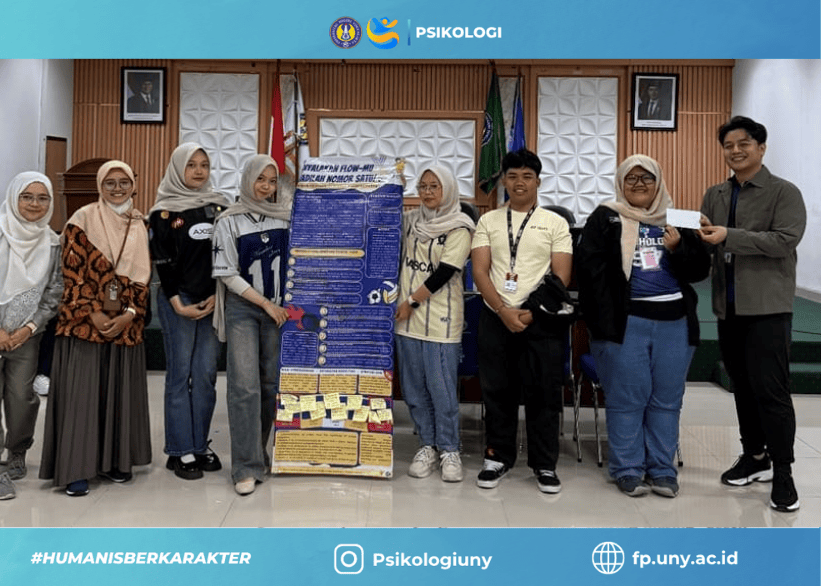
This evaluation format encouraged groups to deliver their best performance, from poster layout to techniques for engaging the audience. Some groups even incorporated thematic props aligned with their research topics, such as wearing sports attributes for athlete-related studies.
The evaluation process also involved the course instructors:
- Dr. Siti Rohmah Nurhayati, M.Si.
- Patera Adwiko Priambodo, M.Psi., Psychologist
- Hanifah Sholihah, S.Psi., M.A.
- Dr. Annisa Reginasari, M.A.
The instructors assessed the accuracy of the content and adherence to scientific standards for each poster, while audience evaluations contributed to the overall performance score, integrated with the final semester assessment.
Awards for the Best Performing Groups
As a form of appreciation, the course coordinator, together with the teaching team, recognized four groups as the best performers based on a combination of instructor and audience evaluations. The selected groups were:
- Fourth Place: Group 5, Class F — “Conformity Phenomena in Generation Z’s Coffee Culture at Street Coffee, Kota Baru, Yogyakarta”
- Third Place: Group 8, Class F — “Academic Self-Efficacy among Visually Impaired Students at Universitas Negeri Yogyakarta”
- Second Place: Group from Class C — “Digital Catharsis: A Qualitative Study of Users’ Experiences in Expressing Negative Emotions on ChatGPT”
- First Place: Group 3, Class F — “Flow Dynamics of Indonesian Athletes During Competitions”
The event concluded with documentation and class cheers led by Patera Adwiko Priambodo, M.Psi., Psychologist, adding warmth to the atmosphere at the end of the activity.
Enhancing Students’ Scientific Dissemination Skills
Through this exhibition, the Faculty of Psychology at UNY encourages students to develop the habit of disseminating research results responsibly and effectively. Although the students’ research is at the learning level, this experience is expected to cultivate awareness of the importance of scientific publication and the contribution of research to the advancement of psychological knowledge. The activity serves as an initial step for students to understand that research does not end with analysis but also involves the ability to reach audiences and contribute to broader scientific discourse.

Contact Us

Faculty of Psychology
Universitas Negeri Yogyakarta
Jl. Kenari No. 6
Umbulharjo, Yogyakarta 55166
Indonesia
Email: humas_fp@uny.ac.id, sekretaris.dekanfp@uny.ac.id
Instagram: @psikologiuny