 Bahasa Indonesia
 English
 Fakultas Psikologi
Universitas Negeri Yogyakarta
Jalan Colombo No. 1
Karangmalang Sleman, Yogyakarta 55281
Indonesia
Alamat surel: humas_fp@uny.ac.id, sekretaris.dekanfp@uny.ac.id
Instagram: @psikologiuny
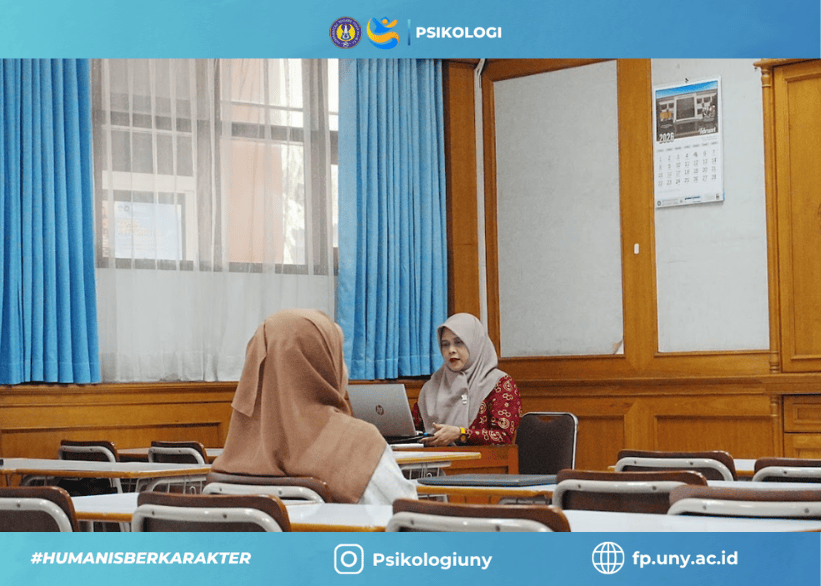
Yogyakarta, February 27, 2026 – The Faculty of Psychology, Universitas Negeri Yogyakarta (UNY), organized a Workshop on the Optimization of Intellectual Property Rights (IPR) Applications on Friday (February 27, 2026) at Classroom 24, Noeng Muhajir Building, Faculty of Education, UNY. The workshop, which began at 13:00 WIB, was attended by 30 participants out of 37 invited guests, consisting of lecturers and educational staff from the Faculty of Psychology.
The workshop aimed to enhance the academic community’s understanding of the importance of intellectual property protection and to encourage the optimization of IPR applications for various academic works produced by lecturers and students. The event was opened by Prof. Farida Agus, followed by remarks from the Dean of the Faculty of Psychology UNY. In her remarks, the Dean expressed her appreciation to all participants for attending the workshop. She emphasized that the Faculty of Psychology has significant potential to produce various works that can be registered as Intellectual Property Rights.
According to her, many academic products developed by lecturers and studentssuch as learning modules, research instruments, and scientific works have strong potential to obtain intellectual property protection. Therefore, this workshop was expected to provide insights into the procedures and requirements for submitting IPR applications. The Dean also highlighted that the Faculty of Psychology needs to prepare for greater independence in submitting intellectual property applications, particularly in meeting the targets established by the university. She also apologized that not all lecturers could attend the event due to several concurrent academic activities.
The main speaker of the workshop was Prof. Elly Rohaeti, a lecturer from the Faculty of Mathematics and Natural Sciences (FMIPA) UNY and the Head of Intellectual Property Affairs at UNY. In her presentation, she explained the fundamental concepts and procedures related to intellectual property rights. Prof. Elly described intellectual property as creations of the human mind arising from intellectual abilities, including inventions in technology, science, literature, and the arts, as well as symbols, names, and images used in commerce. The concept of IPR originates from human ideas and creativity that are transformed into inventions or creative works which deserve recognition and legal protection.
She further explained that intellectual property ownership can generally be categorized into personal ownership and communal ownership. Personal ownership includes copyrights, patents, trademarks, and industrial designs, while communal ownership includes traditional cultural expressions, geographical indications, and traditional knowledge. Prof. Elly also elaborated on various types of works that can be registered as intellectual property. Technological inventions, such as tools or methods, can be registered as patents or simple patents. Artistic, literary, and scientific works can be protected through copyrights. Product designs with aesthetic value can be registered as industrial designs, while commercial signs or services can be registered as trademarks. Additionally, confidential business or technological information can be protected under trade secret rights.
During the session, she also explained several legal frameworks governing intellectual property in Indonesia, including Law No. 28 of 2014 on Copyright, Law No. 20 of 2016 on Trademarks, Law No. 31 of 2000 on Industrial Design, and Law No. 13 of 2016 on Patents. Prof. Elly emphasized that Universitas Negeri Yogyakarta has already produced numerous intellectual property products that have been successfully registered. She encouraged academics to actively protect their works through IPR registration to prevent them from being claimed or used by others without permission.
According to her, works involving technological elements tend to be easier to patent. However, the field of education also holds strong potential to produce works eligible for copyright protection, such as digital learning modules, research instruments, scientific posters, and student projects. She also explained that the university has implemented regulations encouraging undergraduate and graduate students to develop their final projects into works that can be registered for intellectual property protection. Student innovation products can also be proposed for IPR registration with financial support from the university.
In the process of submitting IPR applications, Prof. Elly stressed that complete documentation is essential. Submitted works should include not only the cover but also the full content or results of the work. For student works, the name of the supervising lecturer must also be included as part of the intellectual ownership. In addition, UNY is developing an Innovation Catalog, which compiles works created by lecturers, students, and educational staff. Selected works from this catalog will be evaluated for potential submission to obtain intellectual property protection or patents. Prof. Elly added that the current year has been designated as a significant moment for the academic community to actively pursue patent registration and intellectual property protection.
“Even a simple work consisting of a single page can potentially be registered as intellectual property as long as it meets the required criteria,” she explained. Following the presentation, the workshop continued with a question-and-answer and discussion session, during which participants actively explored topics such as application procedures, types of works eligible for registration, and strategies for developing innovative academic products with intellectual property potential. The workshop concluded at 15:00 WIB. Through this activity, the Faculty of Psychology UNY hopes that lecturers and educational staff will gain a deeper understanding of the importance of protecting intellectual works and become more motivated to register intellectual property for innovations developed within the faculty.

 Fakultas Psikologi