 Bahasa Indonesia
 English
Strengthening Family Support for Older Adults: An Elderly Care Education and Assistance Program Based on Posyandu Lansia
The increasing number of older adults (elderly population) in Indonesia presents both challenges and opportunities in realizing a healthy, independent, and prosperous ageing society. As individuals grow older, they experience various physical, psychological, social, and cognitive changes that require attention and support from their surrounding environment, particularly their families. Within the context of rural communities, families play a crucial role as the primary support system for older adults, including fulfilling daily needs, providing emotional support, and assisting older adults in accessing community-based health services such as Posyandu Lansia (Integrated Health Service Post for Older Adults).
Nevertheless, various challenges remain in the implementation of family-based elderly care and assistance practices. Family knowledge regarding the ageing process and elderly care remains limited, communication between family members and older adults is not always characterized by empathy, and family involvement in Posyandu Lansia activities remains relatively low. These conditions may negatively affect the quality of life of older adults and hinder the optimization of Posyandu Lansia services as an important form of community-based healthcare.
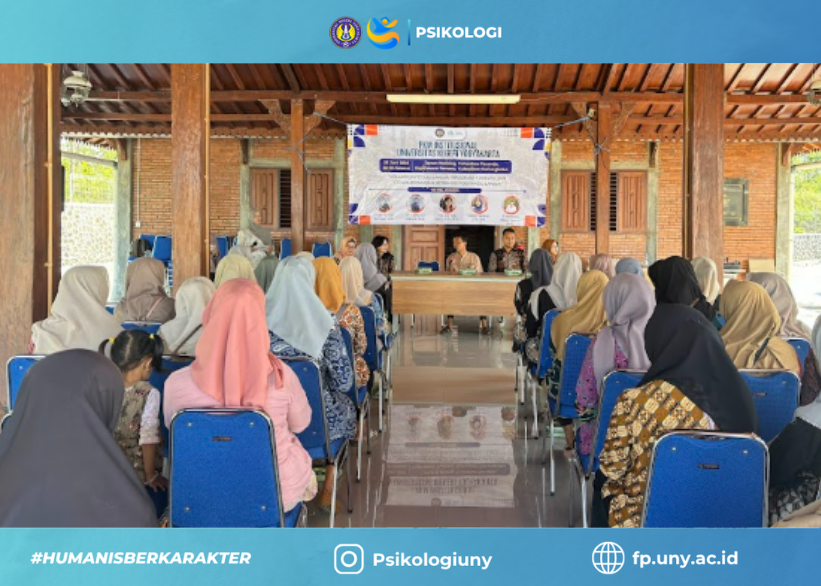
As an implementation of the Tri Dharma of Higher Education, particularly in the field of community service, the Community Service Team of the Faculty of Psychology, Universitas Negeri Yogyakarta (UNY), organized a program entitled “Keluarga Peduli Lansia: Program Edukasi dan Pendampingan Berbasis Posyandu Lansia” (Caring Families for Older Adults: An Education and Assistance Program Based on Posyandu Lansia). The program was conducted on June 28, 2026, at the Vocational Faculty Building of Universitas Negeri Yogyakarta, Wonosari. The primary target groups of this activity were Posyandu Lansia cadres and family members who have older adults in their households in Dusun Kenteng, Kalurahan Pacarejo, Kapanewon Semanu, Gunungkidul Regency.
The activity began with a welcoming speech from the Head of Kenteng Hamlet, who expressed appreciation for the initiative of the Faculty of Psychology UNY in supporting the improvement of elderly care services at the village level. In his speech, he emphasized that the success of community development should not only be measured by the welfare of younger generations but also by how society provides attention and appreciation to older adults as valuable sources of experience, values, and wisdom within families and social environments.
This community service program was designed using a participatory and experiential learning approach, allowing participants not only to receive theoretical knowledge but also to actively engage in various training activities. The training consisted of three main sessions: Elderly Care, Psychological Support and Meaningful Activities for Older Adults, and Empathetic Communication with Older Adults. These three sessions were systematically designed to strengthen family capacity in providing holistic assistance and support for older adults.
In the first session, participants gained knowledge regarding the ageing process, the basic needs of older adults, common health risks experienced by older adults, and the importance of family-based care. Through brainstorming activities, simulations, and role-play exercises, participants were encouraged to understand various challenges faced by older adults in their daily lives, thereby enhancing their empathy toward both the physical and psychological needs of older adults.
The second session focused on the importance of psychological support for older adults. Participants learned about the vulnerability of older adults to loneliness, the importance of feeling valued and appreciated, and various simple activities that can enhance their happiness and psychological well-being. One of the most engaging activities was the role-play activity entitled “Older Adults Who Feel Neglected,” which provided participants with an opportunity to understand the emotional impact of limited attention and communication on older adults. Furthermore, participants discussed various cases commonly encountered within families and collaboratively explored possible solutions based on their personal experiences.
In the third session, participants learned empathetic communication skills as a fundamental foundation for developing healthy relationships with older adults. The materials provided included concepts of effective communication, active listening techniques, the use of open-ended questions, positive affirmation, and strategies for responding empathetically to older adults’ emotions and experiences. Through the role-play activity entitled “Listen to Me for a Moment,” participants practiced directly how attentive and caring communication can help older adults feel heard, valued, and recognized as meaningful members of their families.
The enthusiasm of participants was evident throughout the implementation of the program. Posyandu Lansia cadres and family members actively participated in discussions, shared their experiences, and reflected on the elderly care practices they had previously implemented at home. The training atmosphere was warm and participatory, as participants were provided with opportunities to learn from one another, exchange experiences, and develop collective commitments to improving the quality of elderly assistance within their families and communities.
Through this program, the Faculty of Psychology UNY hopes that families will not only understand how to care for older adults from a physical health perspective but also develop the ability to provide psychological support, establish empathetic communication, and increase active participation in Posyandu Lansia activities. Strengthening family capacity is expected to become one of the strategic approaches to improving the quality of life of older adults while reinforcing the role of Posyandu Lansia as a community-based health service center.
The implementation of this community service activity also contributes to the achievement of the Sustainable Development Goals (SDGs), particularly SDG 3 (Good Health and Well-being), through efforts to improve the health and well-being of older adults based on family and community involvement. In addition, this program supports SDG 10 (Reduced Inequalities) by expanding older adults’ access to healthcare services and social support, as well as SDG 17 (Partnerships for the Goals) through collaboration among higher education institutions, village governments, Posyandu Lansia cadres, and community members in creating a more age-friendly environment.
The Community Service Team of the Faculty of Psychology, Universitas Negeri Yogyakarta, expresses its deepest appreciation to the Pacarejo Village Government, Posyandu Lansia cadres, and all participating families who actively contributed to the success of this program. The established synergy is expected to serve as an initial step toward developing a stronger culture of family care and concern for older adults, enabling them to experience ageing in a healthy, happy, dignified, and meaningful manner while remaining an important part of family and community life.

Contact Us

Faculty of Psychology
Universitas Negeri Yogyakarta
Jl. Kenari No. 6
Umbulharjo, Yogyakarta 55166
Indonesia
Email: humas_fp@uny.ac.id, sekretaris.dekanfp@uny.ac.id
Instagram: @psikologiuny