 Bahasa Indonesia
 English
Faculty of Psychology UNY Organizes Workshop on Optimizing Project-Based Learning to Strengthen Impactful Learning
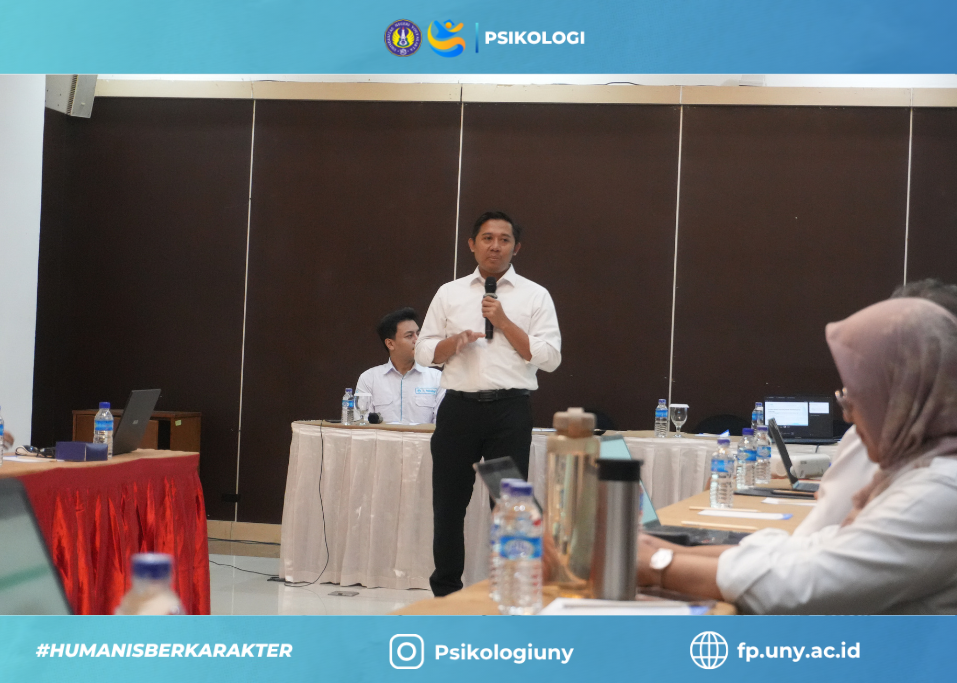
Yogyakarta – The Faculty of Psychology, Universitas Negeri Yogyakarta (UNY), organized a Workshop on Optimizing Project-Based Learning to Strengthen Impactful Learning on Monday, July 20, 2026, at UNY Hotel. The workshop featured Dr. Moh. Abdul Hakim, S.Psi., M.A. from Universitas Sebelas Maret (UNS) as the keynote speaker. The event was attended by faculty members of the Faculty of Psychology UNY as part of the Faculty's commitment to enhancing lecturers' competencies in designing innovative, collaborative, and impactful learning experiences.
The workshop commenced with opening remarks emphasizing the importance of transforming higher education learning to address the demands of the twenty-first century. One of the approaches highlighted was Project-Based Learning (PjBL), a student-centered learning model that encourages students to acquire knowledge and skills through the completion of authentic projects addressing real-world problems.
In his presentation, Dr. Abdul Hakim explained that Project-Based Learning extends beyond knowledge acquisition by fostering critical thinking, problem-solving, collaboration, communication, creativity, and reflective learning. He emphasized that meaningful learning occurs when students actively engage with authentic challenges and apply theoretical concepts to practical situations that generate positive impacts on society.
The workshop explored the fundamental stages of implementing Project-Based Learning, including aligning projects with intended learning outcomes, identifying contextual issues, designing meaningful learning activities, facilitating project implementation, and developing comprehensive assessment strategies. Dr. Abdul Hakim highlighted that assessment in Project-Based Learning should evaluate not only the final product but also students' learning processes, teamwork, critical thinking, creativity, communication, and reflective practice.
Participants also discussed practical strategies for integrating Project-Based Learning into higher education curricula, including course planning, semester learning plans, authentic assessment rubrics, and collaboration with external stakeholders to enrich students' learning experiences. Drawing upon successful practices implemented at Universitas Sebelas Maret, the speaker demonstrated how Project-Based Learning can create more engaging and impactful educational experiences while strengthening graduates' competencies for future professional challenges.
The workshop featured active discussions among participants regarding the opportunities and challenges of implementing Project-Based Learning within psychology education. Faculty members exchanged ideas on adapting the approach to psychology courses, managing student projects, supervising collaborative learning, and evaluating learning outcomes effectively. The interactive sessions encouraged participants to reflect on innovative teaching practices that are responsive to societal needs and developments in psychological science.
Through this workshop, the Faculty of Psychology UNY reaffirmed its commitment to continuously improving the quality of teaching and learning by strengthening lecturers' pedagogical competencies and promoting educational innovation. The adoption of Project-Based Learning is expected to create more meaningful learning experiences, increase student engagement, and prepare graduates who are adaptable, creative, collaborative, and capable of contributing to society through evidence-based solutions.
Furthermore, the workshop strengthened academic collaboration between higher education institutions and encouraged the exchange of best practices in innovative teaching and learning. Such initiatives reflect the Faculty's ongoing efforts to foster a culture of continuous improvement and educational excellence in line with national and international higher education developments.
Contribution to the Sustainable Development Goals (SDGs)
This workshop contributes to several United Nations Sustainable Development Goals (SDGs), particularly SDG 4 (Quality Education) by enhancing lecturers' pedagogical competencies and promoting innovative learning approaches, SDG 8 (Decent Work and Economic Growth) by equipping students with competencies relevant to future employment and professional practice, and SDG 17 (Partnerships for the Goals) through academic collaboration between Universitas Negeri Yogyakarta and Universitas Sebelas Maret in advancing the quality of higher education.

Contact Us

Faculty of Psychology
Universitas Negeri Yogyakarta
Jl. Kenari No. 6
Umbulharjo, Yogyakarta 55166
Indonesia
Email: humas_fp@uny.ac.id, sekretaris.dekanfp@uny.ac.id
Instagram: @psikologiuny