 Bahasa Indonesia
 English
Sustainable Career Coaching for Senior High School Guidance and Counseling Teachers in Sleman Regency: Strengthening Career Counseling Services to Enhance Students' Readiness for the Future of Work
The rapidly evolving world of work, driven by technological advancement, digital transformation, and the increasing adoption of Artificial Intelligence (AI), requires students to develop stronger career readiness from an early stage of their education. These changes present new challenges for Guidance and Counseling (GC) teachers, who serve as the frontline professionals in helping students identify their strengths, explore career opportunities, and make informed career decisions. Consequently, GC teachers are no longer expected merely to provide information about higher education and employment opportunities but are also required to act as career coaches who facilitate students' career development through continuous coaching and career counseling processes.
Despite this growing demand, career guidance services in many schools continue to face significant challenges. Existing services often emphasize providing information about university majors or educational pathways, while students' self-exploration, reflective thinking, and career decision-making processes receive less attention. As a result, many senior high school students remain uncertain about their educational and career choices after graduation. This situation highlights the urgent need to strengthen GC teachers' competencies in implementing more participatory, reflective, and student-centered career coaching approaches.
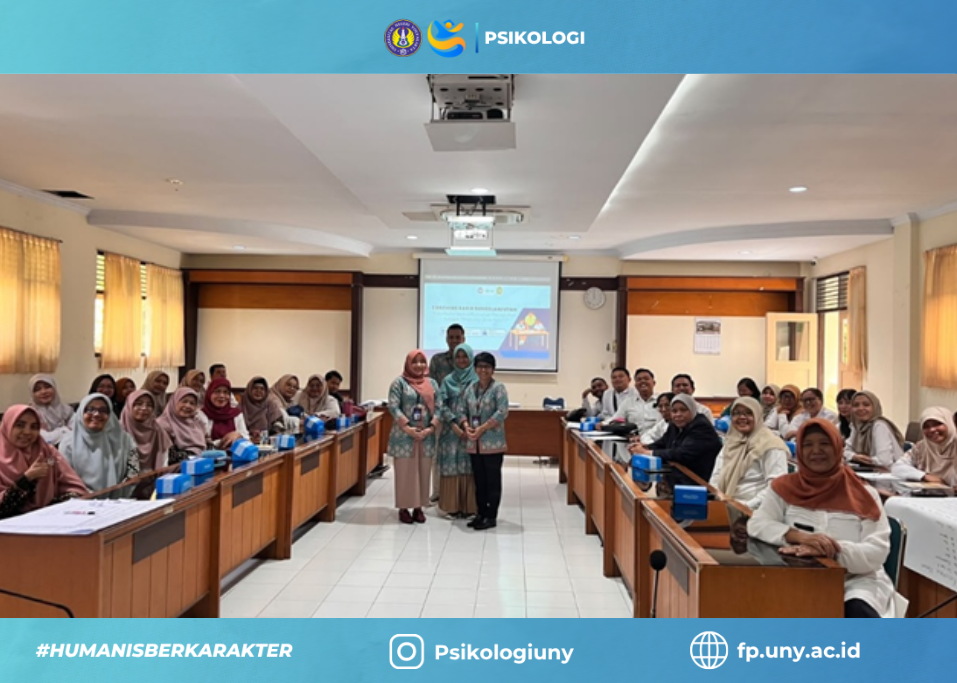
As part of the implementation of the Tri Dharma of Higher Education, particularly in the area of community engagement, the Community Service Team of the Faculty of Psychology, Universitas Negeri Yogyakarta (UNY), organized a community service program entitled "Sustainable Career Coaching: Utilizing Career Counseling to Enhance Readiness for the Future of Work." The program was conducted on 29 July 2026 in collaboration with the Guidance and Counseling Teachers' Association (MGBK) of Sleman Regency and was attended by 40 senior high school Guidance and Counseling teachers representing various schools across Sleman Regency. This initiative reflects the Faculty of Psychology UNY's commitment to strengthening the professional capacity of GC teachers in delivering career services that are responsive to the rapidly changing employment landscape.
The program commenced with an opening session and welcoming remarks delivered by representatives of MGBK Sleman Regency, who expressed their appreciation for the collaboration established between the Faculty of Psychology UNY and MGBK in supporting the professional development of Guidance and Counseling teachers. The speakers emphasized that strengthening career guidance services has become increasingly important due to the evolving nature of the labor market and the growing complexity of higher education and career choices faced by senior high school students.
The first session focused on career coaching as an innovative approach to school guidance and counseling services. Participants gained insights into current labor market transformations, emerging career trends, and the expanding role of Guidance and Counseling teachers as career coaches who empower students to identify their strengths, personal values, interests, and long-term career goals. In addition, participants were introduced to the fundamental principles of coaching, empowering communication techniques, active listening, powerful questioning, and the GROW Model as a structured framework for facilitating students' career decision-making processes.
The second session explored career counseling as a developmental support process that assists students in overcoming challenges related to career planning and decision-making. Through this approach, Guidance and Counseling teachers are encouraged not only to provide educational and occupational information but also to facilitate students' self-understanding, exploration of career alternatives, and readiness to navigate an increasingly dynamic world of work. The session was grounded in career exploration and career development theories, emphasizing the importance of self-awareness and personal potential as essential foundations for effective career decision-making.
Beyond the presentations, the program was designed to be highly interactive through case-based discussions derived from participants' real experiences in schools. Teachers collaboratively analyzed common issues encountered in career counseling services, including students' uncertainty regarding post-secondary educational pathways, differences between students' aspirations and parental expectations, and students' lack of confidence in making career decisions. These discussions provided valuable opportunities for professional reflection, peer learning, and the exchange of effective coaching and counseling strategies.
Participants demonstrated strong enthusiasm throughout the program. Guidance and Counseling teachers actively shared their experiences in delivering career services, discussed the challenges they encounter in their respective schools, and exchanged practical strategies that have been implemented to support students' career development. The dynamic interaction between the facilitators and participants reflected the growing need for strengthening career coaching competencies as an integral component of comprehensive school counseling services.
Through this program, it is expected that Guidance and Counseling teachers will develop a more comprehensive understanding of career coaching and career counseling practices, enabling them to guide students more systematically in exploring their potential, planning their future careers, and preparing for the demands of the contemporary workforce. Strengthening these competencies is anticipated not only to improve the quality of career guidance services in schools but also to contribute to the development of senior high school graduates who are better prepared to pursue higher education and compete successfully in an increasingly dynamic and competitive labor market.
This community engagement program also contributes to the achievement of several United Nations Sustainable Development Goals (SDGs). It supports SDG 3 (Good Health and Well-being) by promoting students' psychological well-being during career decision-making processes and strengthening the capacity of Guidance and Counseling teachers as psychosocial facilitators within schools. Furthermore, the program advances SDG 4 (Quality Education) by enhancing teachers' professional competencies in delivering high-quality career guidance and counseling services. It also contributes to SDG 17 (Partnerships for the Goals) through the collaborative partnership between the Faculty of Psychology, Universitas Negeri Yogyakarta, and the Guidance and Counseling Teachers' Association (MGBK) of Sleman Regency in developing educators' capacities and improving the quality of educational services.
The Community Service Team of the Faculty of Psychology, Universitas Negeri Yogyakarta, extends its sincere appreciation to the Guidance and Counseling Teachers' Association (MGBK) of Sleman Regency for its strong collaboration and support, which contributed significantly to the successful implementation of this program. It is hoped that this partnership will continue through future professional development initiatives for Guidance and Counseling teachers, thereby strengthening the quality of career coaching and counseling services in schools and supporting the development of Indonesian youth who are career-ready, resilient in the face of change, and globally competitive.

Contact Us

Faculty of Psychology
Universitas Negeri Yogyakarta
Colombo Street Number 1
Karangmalang, Sleman, Yogyakarta 55281
Indonesia
Email: humas_fp@uny.ac.id, sekretaris.dekanfp@uny.ac.id
Instagram: @psikologiuny