 Bahasa Indonesia
 English
UNY Faculty of Psychology Conducts Digital Parenting Literacy Training for Parents in Kampung Emas, Gunungkidul
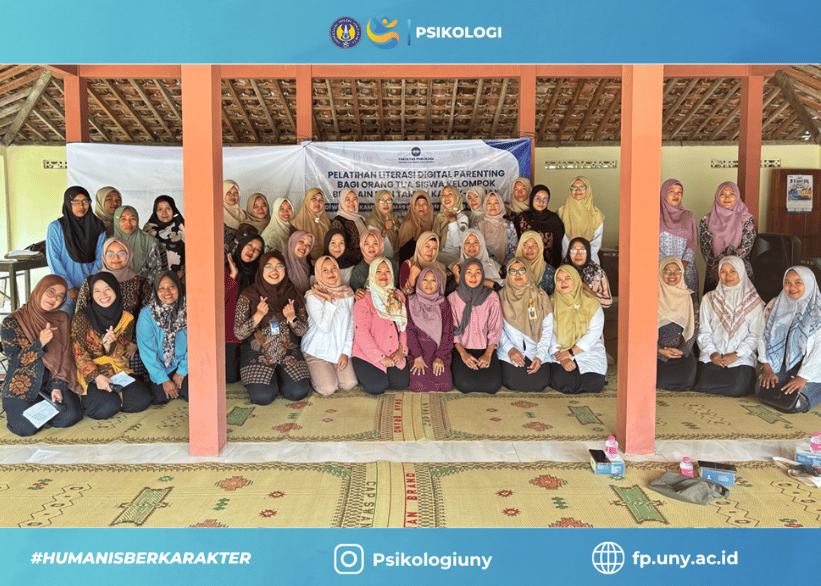
Gunungkidul, April 29, 2026 – The Faculty of Psychology, Universitas Negeri Yogyakarta (UNY), through its Community Engagement Program led by Professors and Structural Academic, Student Affairs, Alumni, and Partnership (AKA RK) Faculty Members, organized a community service program entitled "Digital Parenting Literacy Training for Parents of Playgroup and Kindergarten Students in the Kampung Emas Areas of Kepuh and Kenteng, Gunungkidul." The training was held on Wednesday, April 29, 2026, at KB Bunga Bangsa, Kenteng Hamlet, Pacarejo Village, Semanu District, Gunungkidul Regency.
The program was attended by 38 participants consisting of parents and teachers from KB Bunga Bangsa and TK ABA Kenteng. The initiative reflects the Faculty of Psychology's commitment to strengthening family capacity and supporting early childhood education by equipping parents and educators with essential knowledge and practical skills for guiding children's digital media use in today's technology-driven environment.
The program was delivered by four faculty members from the Faculty of Psychology, Universitas Negeri Yogyakarta: Dr. Suwarjo, M.Si.; Eva Rahman, M.Psi., Psychologist; Dinarista Yulisa Ediputri, M.Psi., Psychologist; and Kumala Windya Rochmani, M.Psi., Psychologist. The implementation was further supported by five students serving as the technical team, comprising two Master's students in Psychology—Adistya Nurwahyuni and Anastasya Anif Luthfikri—and three Undergraduate Psychology students—Resti Aryani Widyaningsih, Dyah Ayu Febri Setyaningsih, and Nadifah Febri Nanda Pramika. The collaboration between faculty members and students exemplifies the integration of education, research, and community engagement as part of the university's implementation of the Tri Dharma of Higher Education.
The event was officially opened by Dr. Suwarjo, M.Si., who served as the program coordinator, followed by welcoming remarks from Kartini, S.Pd., representing TK ABA Kenteng. During her remarks, representatives from TK ABA Kenteng and KB Bunga Bangsa expressed their appreciation for the Faculty of Psychology's contribution in enhancing parents' understanding of effective parenting practices and strengthening their capacity to guide children in using digital technology responsibly and safely.
The training consisted of a series of interconnected sessions designed to combine theoretical knowledge with practical application. The first session, Understanding Child Development, introduced participants to the developmental characteristics of young children as a foundation for appropriate parenting practices. This was followed by an interactive reflection session facilitated by Kumala Windya Rochmani, M.Psi., Psychologist, encouraging parents to share and evaluate their daily parenting experiences.
The subsequent session, Recognizing Parenting Styles, was delivered by Dr. Suwarjo, M.Si., who discussed various parenting approaches and their influence on children's psychological and social development. Participants then attended Children in the Digital World, presented by Dinarista Yulisa Ediputri, M.Psi., Psychologist, which explored both the opportunities and challenges associated with children's digital technology use. During this session, participants completed a Parental Reflection Worksheet and a Children's Gadget Use Checklist to assess their current parenting practices related to digital media.
The final session focused on Common Digital-Related Issues Among Children and Practical Strategies for Addressing Them. Participants completed the Navigating Children's Digital World Worksheet, which provided practical guidance for establishing healthy digital habits, promoting positive parent–child communication, and implementing age-appropriate digital media rules at home. The program concluded with an interactive discussion and question-and-answer session, allowing participants to consult directly with the speakers regarding parenting challenges encountered in their daily lives.
As part of the program evaluation, participants completed knowledge questionnaires before and after the training to measure changes in their understanding of digital parenting concepts. The high level of participant engagement was evident throughout the event, as reflected in the active discussions, enthusiastic participation in practical activities, and the willingness of parents to openly share their experiences and concerns regarding children's gadget use and digital media exposure.
Through this initiative, the Faculty of Psychology, Universitas Negeri Yogyakarta, reaffirms its commitment to the Tri Dharma of Higher Education, particularly in the area of community engagement, by delivering evidence-based psychological knowledge that supports family well-being and strengthens community resilience in the digital era. The faculty hopes that the training will empower parents and teachers to create safe, supportive, and developmentally appropriate environments that enable children to benefit from digital technology while minimizing its potential risks.
This program also contributes to the achievement of the United Nations Sustainable Development Goals (SDGs), particularly SDG 3 (Good Health and Well-being) by promoting children's and families' psychological well-being, SDG 4 (Quality Education) by strengthening parents' and educators' digital parenting competencies, and SDG 17 (Partnerships for the Goals) through collaborative engagement between the university, educational institutions, and local communities to foster sustainable family and child development.

Contact Us

Faculty of Psychology
Universitas Negeri Yogyakarta
Colombo Street Number 1
Karangmalang, Sleman, Yogyakarta 55281
Indonesia
Email: humas_fp@uny.ac.id, sekretaris.dekanfp@uny.ac.id
Instagram: @psikologiuny