 Bahasa Indonesia
 English
UNY Faculty of Psychology Partners with SMA Negeri 1 Wonosari to Hold Strength-Based Parenting Psychoeducation Program, Equipping Parents to Support Students During Exam Season and Higher Education Decisions
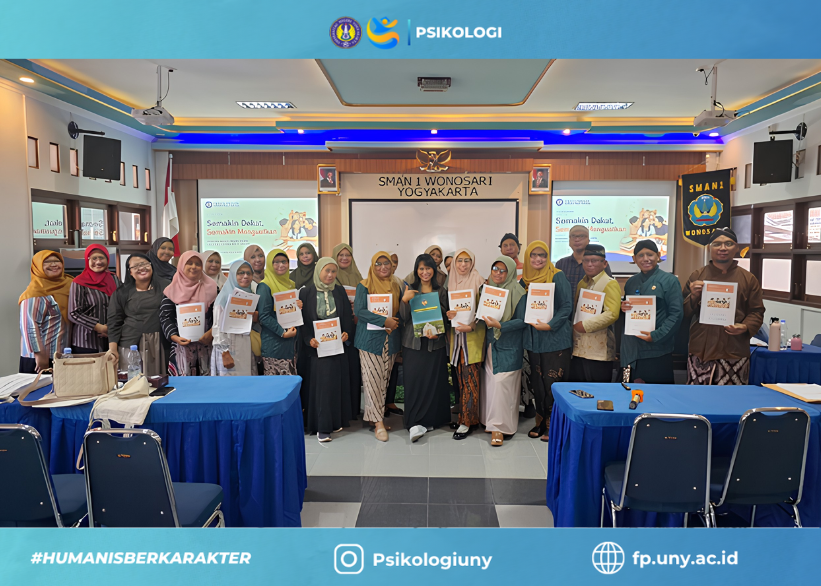
WONOSARI — Exam season can be a particularly stressful time at home. Students are busy studying while also feeling uncertain about their future, while parents may share the anxiety but often struggle to find ways to help without adding to the pressure. This situation was addressed through the psychoeducation program “Semakin Dekat, Semakin Menguatkan” (Growing Closer, Growing Stronger), organized by the Faculty of Psychology, Universitas Negeri Yogyakarta (UNY), in collaboration with SMA Negeri 1 Wonosari on Thursday, July 30, 2026, specifically for parents of students.
Held at SMA Negeri 1 Wonosari, the program featured psychologist and lecturer at the Faculty of Psychology UNY, Wresti Wrediningsih, as the main speaker. She was accompanied by three facilitators, who are also psychologists and lecturers in Psychology at UNY: Kumala Widya Rochmani, A’yunin Akrimni Darojat, and Ika Wahyu Pratiwi.
The event was officially opened by the Vice Principal for Curriculum, Mr. Aris, accompanied by the Coordinator of Cooperation, Mr. Anang Saputro. In his remarks, the school emphasized that programs such as this complement the school’s efforts to support students, particularly amid the academic pressure they face as they approach graduation.
Why Do We Find It Easier to See Our Children’s Weaknesses?
Wresti opened the session with a simple question that prompted many parents to pause and reflect: “The last time you looked at your child’s report card, which grade did your eyes notice first—the best one or the lowest one?”
According to her, this reflex does not mean that parents do not care about their children. “Our brains are naturally designed to detect problems more quickly than positive things. This is called the negativity bias. But when this becomes a constant habit, children may eventually feel that their parents only notice their shortcomings,” she explained.
The approach introduced during the session was Strength-Based Parenting, a parenting style that intentionally encourages parents to recognize and nurture their children’s character strengths rather than focusing solely on correcting mistakes. International research presented during the session suggests that adolescents whose strengths are recognized by their parents tend to have greater self-confidence, better resilience in dealing with pressure, and closer relationships with their parents.
More Than Just Theory: Parents Put the Concepts into Practice
Unlike a conventional seminar, all participants were actively engaged throughout the three-hour program. Following the procedures outlined in the module developed by the facilitation team, parents participated in role-playing activities, personal reflection, and small-group discussions in which they shared their parenting experiences.
One of the activities that generated the most discussion was a simulation called “Staying Present in Difficult Moments.” Parents practiced responding to children who were being defensive or withdrawing—situations that facilitators noted are highly familiar to parents of high school students.
“Teenagers do not always respond positively, and sometimes they may even push their parents away. But when parents remain consistently warm and supportive in those moments, children learn to trust that their parents will not leave them when they are going through difficult times,” one of the facilitators explained during the group reflection session.
Good News for Parents of Grade 12 Students
For parents of Grade 12 students, the program featured a special session focusing on an equally important issue: supporting children in choosing their future field of study or career based on their strengths, rather than simply following popular majors or social pressure.
Research presented during the session showed that adolescents who view major life decisions, such as choosing a university major, as opportunities for growth and who feel a sense of control over their own choices tend to have a more positive future orientation and feel calmer when facing the transition to higher education.
During this session, parents were introduced to a simple tool called the “Career Strengths Compass,” which helps map children’s strengths and connect them with possible fields of study. Parents were also trained to formulate empowering opening questions to initiate conversations about the future with their children. For example, instead of immediately asking—or even deciding—which major their child should choose, parents can ask which areas make their child feel most engaged, energized, and alive.
“Grade 12 students are dealing with many pressures at once: examinations, family expectations, and uncertainty about the future. The way parents respond at this stage can make a real difference in whether children feel supported or even more burdened,” said Wresti.
What Parents Had to Say
The participants’ enthusiasm was also reflected in the evaluation forms completed after the program. Several parents shared meaningful reflections on how their perspectives toward their children had begun to change.
“I am currently looking for the strength to encourage my child as they prepare for the UTBK.”
— Maharani, parent of a Grade 12 student
“As a parent, I am learning not to place demands on my child. It turns out that when we start seeing our child’s strengths, we can become calmer.”
— Fen, parent of a Grade 12 student
Another participant summarized the experience in a simple sentence: “Learning about parenting seems easy, but putting it into practice is difficult,” wrote Zul.
Meanwhile, Yuli, another parent, said that the program “provided valuable education for parents, particularly those of Grade 12 students, in supporting their children’s next stage of education.” Her comment reflects one of the key needs addressed by the program—an aspect that is often overlooked in conventional parenting programs.
Small Changes, Big Impact
As the program drew to a close, all participants wrote down a personal commitment describing one small step they would try to implement with their children during the following week. Some participants also exchanged contact information as a way of building peer support among parents, a mechanism designed by the facilitation team to help ensure that the positive momentum developed during the program would continue beyond the training itself.
The school welcomed the parents’ enthusiasm throughout the program and expressed hope that similar initiatives could continue in the future. Such programs are expected to support the school’s efforts to build an educational ecosystem that focuses not only on academic achievement but also on students’ overall psychological well-being.
The “Semakin Dekat, Semakin Menguatkan” (Growing Closer, Growing Stronger) program was part of a Community Service Program (Pengabdian kepada Masyarakat/PkM) initiated by the Faculty of Psychology, Universitas Negeri Yogyakarta. The program aims to strengthen the role of families in supporting the psychological well-being of Indonesian adolescents.

Contact Us

Faculty of Psychology
Universitas Negeri Yogyakarta
Jl. Kenari No. 6
Umbulharjo, Yogyakarta 55166
Indonesia
Email: humas_fp@uny.ac.id, sekretaris.dekanfp@uny.ac.id
Instagram: @psikologiuny