 Bahasa Indonesia
 English
From the Faculty of Psychology to the Airwaves: Guardian of the Future Amplifies the Anti-Bullying Movement
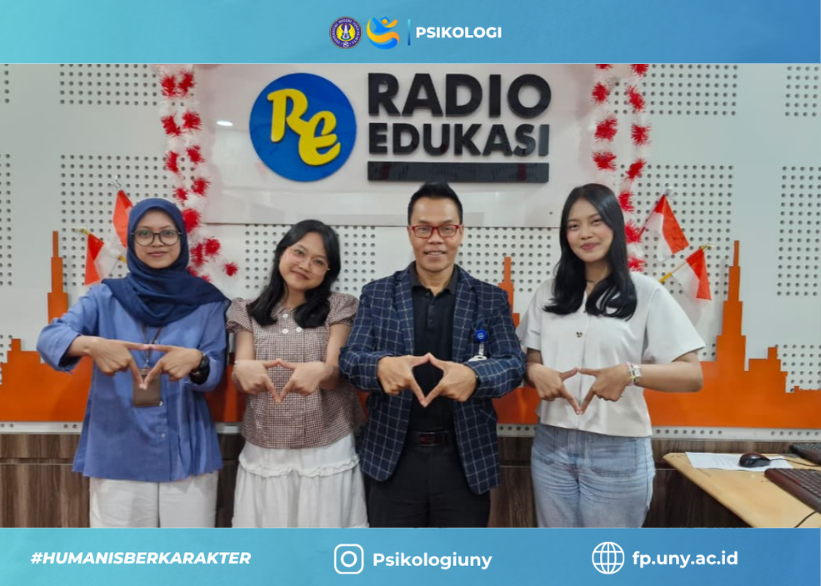
YOGYAKARTA — Creating safe, inclusive, and supportive educational environments requires more than responding to bullying after it occurs. It also calls for preventive efforts that empower students to care for one another and actively contribute to a healthier school culture. This commitment was reflected in the initiative of students from the Faculty of Psychology, Universitas Negeri Yogyakarta (UNY), who are part of the Student Creativity Program for Community Service (PKM-PM) team Guardian of the Future. On Thursday, August 27, 2026, the team took part in an educational broadcast on Radio Edukasi BBGTK DIY to raise awareness about bullying prevention and expand the reach of their community engagement program. The radio appearance formed part of the Guardian of the Future dissemination activities. Through the broadcast, the team introduced its ideas, objectives, and approach to a broader audience while emphasizing the importance of involving students as active contributors to the creation of safe and psychologically supportive school environments. Representing the Guardian of the Future team were Daffina Titania Alfanda from the Faculty of Psychology, UNY, as the person in charge of the activity, and Alfisyah from the Guidance and Counseling Study Program. They appeared in the Intermezo session of Radio Edukasi BBGTK DIY, hosted by Kak Fifah and Kak Yuda.
Addressing Bullying Through Psychological and Educational Perspectives
The discussion began with the issue of bullying in educational settings and its potential implications for students' psychological and social well-being. Bullying is not merely a matter of interpersonal conflict among students. It may also affect students' sense of safety, social relationships, emotional experiences, and overall participation in school life. For this reason, bullying prevention needs to go beyond intervention after an incident has occurred. Schools need to foster environments that encourage empathy, mutual respect, healthy communication, social responsibility, and the confidence to respond when students encounter behaviors that may harm others. These principles form part of the foundation of Guardian of the Future. The program seeks to encourage students to become active participants in bullying prevention within their school communities. Rather than positioning students solely as recipients of information, the program recognizes their potential to contribute to positive social change within their own peer environments.
Empowering Students Through Peer Educators
One of the central approaches introduced through Guardian of the Future is the development of peer educators. Through this approach, students are equipped with knowledge and basic skills that can support bullying prevention efforts among their peers. Peer educators have an important role because peer relationships are highly significant in adolescents' everyday lives. Students often interact with their peers in situations where they may feel more comfortable sharing concerns, seeking initial support, or discussing social experiences. In the context of bullying prevention, peer educators are not intended to replace teachers, school counselors, psychologists, or other professionals. Rather, they are expected to become part of a broader support network within the school. Their role may include encouraging empathy and awareness, providing initial peer support, recognizing situations that require further attention, and encouraging students to seek appropriate assistance when more serious concerns arise. This approach reinforces the idea that preventing bullying is a shared responsibility. Students, teachers, school counselors, parents, and other members of the educational community each have an important role in creating an environment where every student can feel respected, accepted, and safe.
Cross-Disciplinary Collaboration for Safer Schools
Guardian of the Future was developed by a team of students from different study programs. The involvement of students from the Faculty of Psychology, UNY, strengthens the program's attention to psychological dimensions, including empathy, social support, interpersonal relationships, and psychological safety in educational environments. Meanwhile, collaboration with students from the Guidance and Counseling Study Program contributes perspectives related to student assistance, counseling, and the development of students' capacities to support one another. The collaboration enables bullying to be understood not merely as a behavioral issue, but also as a psychological and social phenomenon that requires educational and preventive approaches. Such cross-disciplinary collaboration is one of the strengths of Guardian of the Future. Challenges in educational environments are multidimensional and therefore require cooperation among individuals with different areas of expertise. Through student collaboration, academic knowledge can be translated into community engagement initiatives that respond more closely to real educational needs.
Radio as a Platform for Public Education and Dissemination
The team's participation in Radio Edukasi BBGTK DIY also highlights the role of communication media in expanding the impact of community engagement initiatives. Ideas and educational messages developed through the Guardian of the Future program can reach audiences beyond the immediate setting of its activities through radio broadcasting. The broadcast provided an opportunity to introduce the team's approach to a wider audience while opening a broader conversation about bullying prevention. Media platforms such as radio can serve as a bridge between academic knowledge and community needs, particularly when discussing psychological and educational issues in an accessible way. More importantly, the broadcast contributed to a broader collective understanding that bullying prevention requires the involvement of multiple actors within the educational ecosystem. Knowledge about bullying needs to be translated into awareness, empathy, and concrete action in order to contribute to meaningful changes in the way students interact with one another.
Contributing to the Sustainable Development Goals
The values promoted through Guardian of the Future are also aligned with the United Nations Sustainable Development Goals (SDGs), particularly SDG 3: Good Health and Well-being, SDG 4: Quality Education, and SDG 16: Peace, Justice and Strong Institutions. By promoting psychologically and socially safer school environments, the program contributes to SDG 3 through its attention to students' well-being. A supportive educational environment can provide students with a greater sense of safety and enable them to participate in learning and social activities without fear arising from bullying and harmful peer interactions. The initiative is also closely connected to SDG 4, particularly the broader goal of supporting inclusive and quality education. A safe learning environment is an essential component of meaningful educational participation, allowing students to learn, interact, and develop without being marginalized or exposed to violence and bullying. Furthermore, the promotion of mutual respect, social responsibility, student participation, and violence prevention in schools resonates with SDG 16, which promotes peaceful and inclusive societies. At the school level, these principles can be reflected through healthy interpersonal relationships, constructive responses to conflict, and active participation in creating safe and inclusive educational communities. From this perspective, bullying prevention is not only about protecting students from harmful behavior. It is also part of a broader effort to nurture a generation that values empathy, respects differences, participates responsibly in their communities, and contributes to more inclusive social environments.
From Awareness to Collective Action
Through Guardian of the Future, students from the Faculty of Psychology, UNY, and their cross-disciplinary team seek to bring bullying prevention closer to students' everyday experiences. Their participation in Radio Edukasi BBGTK DIY represents another step in ensuring that the message extends beyond the immediate program setting and reaches a wider educational community. The team hopes that bullying education will not stop at increasing knowledge. More importantly, it should encourage students and members of the educational community to care, recognize bullying behaviors, and take appropriate action when they encounter situations that require attention. The development of peer educators is one of the approaches intended to nurture this culture from within the student community. With appropriate support from schools and guidance from competent professionals, students can become part of a supportive social network that encourages healthier relationships and a safer school environment. Ultimately, Guardian of the Future carries a simple but important message: creating schools free from bullying is not the responsibility of a single individual or institution. It requires the courage to speak up, the willingness to care for one another, and collaboration among students, educators, families, and other stakeholders.
From the university campus, the message traveled into the public sphere through the airwaves. From education, may awareness grow. From awareness, may courage to act follow. Because creating a safe educational environment is not merely about stopping bullying—it is about building a culture in which every student feels respected, heard, supported, and never alone.

Contact Us

Faculty of Psychology
Universitas Negeri Yogyakarta
Jl. Kenari No. 6
Umbulharjo, Yogyakarta 55166
Indonesia
Email: humas_fp@uny.ac.id, sekretaris.dekanfp@uny.ac.id
Instagram: @psikologiuny