 Bahasa Indonesia
 English
UNY Faculty of Psychology Strengthens Early Childhood Teachers' Competencies in Early Developmental Screening in East Lombok
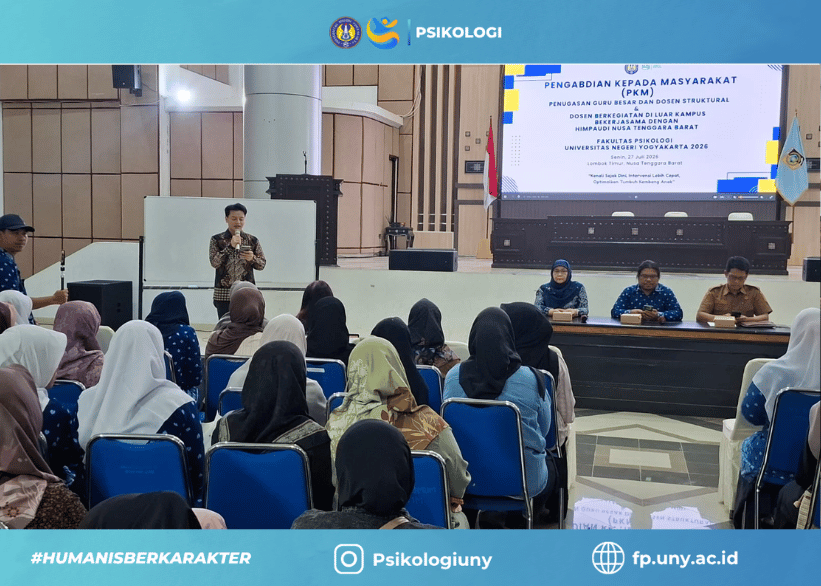
East Lombok – The Faculty of Psychology, Universitas Negeri Yogyakarta (UNY), conducted a community engagement program aimed at strengthening the competencies of Early Childhood Education (PAUD) teachers in conducting early childhood developmental screening. The program was organized in collaboration with the East Lombok Office of Education and Culture and the Early Childhood Education Teachers Association (HIMPAUDI) of West Nusa Tenggara Province to support the improvement of early childhood education services.
The initiative was carried out in response to the growing demand for early childhood education services in East Lombok Regency. According to data from the East Lombok Office of Education and Culture, the number of PAUD institutions and other non-formal education providers has continued to increase over recent years, highlighting the need to strengthen educators' professional competencies alongside the expansion of educational access.
L. M. Jauhari Marjani, Head of the Early Childhood and Non-Formal Education Division of the East Lombok Office of Education and Culture, explained that the increasing number of early childhood education institutions reflects the community's strong commitment to providing educational opportunities for young children. He emphasized that this development should be accompanied by continuous efforts to enhance teacher professionalism and educational quality.
Representing the Faculty of Psychology UNY's community engagement team, Dr. Rita Eka Izzaty, M.Si., Psychologist, delivered a series of sessions focusing on early developmental screening for children aged four to six years. She highlighted the importance of strengthening the competencies of both teachers and parents in identifying developmental milestones and recognizing potential developmental delays at an early stage.
According to Dr. Rita Eka Izzaty, teachers and parents play complementary roles in supporting children's psychological and developmental growth. Therefore, the community engagement program was designed through two parallel capacity-building activities—one focusing on educators and the other on parents—to encourage collaborative monitoring of children's development within both school and home environments.
Throughout the program, participants were introduced to practical developmental screening instruments and evidence-based early intervention strategies that can be implemented in educational settings and within families. Hands-on practice sessions enabled teachers to develop practical skills in identifying developmental concerns and determining appropriate early responses to support children's learning and well-being.
The participants also engaged in interactive discussions addressing common challenges in early childhood education, including monitoring children's motor, language, cognitive, and socio-emotional development. These discussions encouraged the exchange of experiences while promoting the application of psychological knowledge in educational practice.
Usman, Vice Chair of HIMPAUDI of West Nusa Tenggara Province, expressed his appreciation for the collaboration between the Faculty of Psychology UNY, the local government, and HIMPAUDI. He noted that the partnership has made a meaningful contribution to strengthening teachers' professional capacities while fostering closer collaboration between educators and parents in supporting children's holistic development.
Through this initiative, the Faculty of Psychology, Universitas Negeri Yogyakarta, reaffirmed its commitment to the Tri Dharma of Higher Education, particularly community engagement, by disseminating evidence-based psychological knowledge that supports early childhood education and promotes children's optimal development. The program is expected to enhance the capacity of teachers and parents to conduct early developmental screening, enabling children to receive timely educational and developmental support.
This community engagement program also contributes to the achievement of the United Nations Sustainable Development Goals (SDGs), particularly SDG 3 (Good Health and Well-being) by promoting early developmental screening and children's psychological well-being, SDG 4 (Quality Education) by strengthening the professional competencies of early childhood educators, and SDG 17 (Partnerships for the Goals) through collaboration among higher education institutions, local government, professional organizations, and communities to improve the quality of early childhood education.

Contact Us

Faculty of Psychology
Universitas Negeri Yogyakarta
Colombo Street Number 1
Karangmalang, Sleman, Yogyakarta 55281
Indonesia
Email: humas_fp@uny.ac.id, sekretaris.dekanfp@uny.ac.id
Instagram: @psikologiuny